
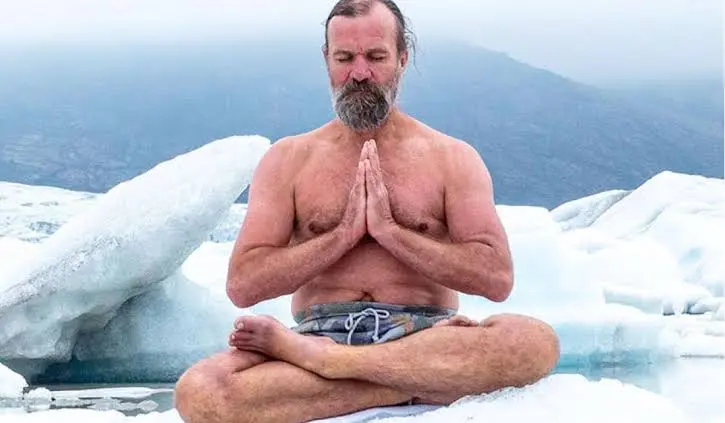
Wim Hof, known worldwide as “The Iceman,” has fundamentally challenged scientific understanding of human physiological limits through his extraordinary feats of cold endurance and his development of a comprehensive method combining breathwork, cold exposure, and mental training. His achievements—which include climbing Mount Kilimanjaro in shorts, running a half marathon above the Arctic Circle barefoot, and standing in a container filled with ice cubes for extended periods—initially appeared to be anomalous abilities unique to one exceptional individual. However, groundbreaking research has demonstrated that Hof can teach others to replicate many of these effects, suggesting that conscious control over supposedly “involuntary” physiological processes may be more accessible than previously believed.
The Wim Hof Method: Three Pillars of Physiological Control
The Wim Hof Method rests on three interconnected pillars: specialized breathing techniques, gradual cold exposure, and commitment/mindset training. This combination creates a comprehensive protocol for enhancing resilience, reducing inflammation, and gaining conscious influence over the autonomic nervous system.
The Breathing Technique: The Wim Hof breathing protocol involves a specific pattern of controlled hyperventilation followed by breath retention. Practitioners take 30-40 deep breaths, fully inhaling and then letting the breath go naturally without forcing the exhale. After the final breath, practitioners exhale and hold their breath for as long as comfortable, often achieving retention times that increase dramatically with practice. This cycle is typically repeated 3-4 times. The breathing uses the diaphragm and involves breathing out through the mouth, letting the breath go naturally on the outflows rather than pushing the air out.
This breathing pattern differs significantly from other breathwork approaches like box breathing (the 4-4-4-4 pattern of 4 seconds inhale, 4 hold, 4 exhale, 4 hold used by military personnel and athletes). The Wim Hof breathing technique creates specific physiological effects, including alkalization of the blood, increased adrenaline release, and temporary oxygen saturation changes that appear to influence immune function and stress response.
Cold Exposure: The second pillar involves progressive cold exposure, beginning with cold showers and potentially advancing to ice baths or outdoor cold immersion. The cold exposure component serves multiple purposes: it activates brown adipose tissue (BAT) and cold-induced thermogenesis (CIT), enhances metabolic function, trains stress resilience, and appears to have anti-inflammatory effects. Research has tested the effects of frequent extreme cold exposure on brown adipose tissue and cold-induced thermogenesis, demonstrating measurable physiological adaptations.
Commitment and Mindset: The third pillar emphasizes the mental component—the conviction and focus required to maintain the practice and push through discomfort. Hof teaches that the mind can be trained to override instinctive responses to cold and other stressors, creating a foundation for greater physiological control.
The Groundbreaking Research: Proving Voluntary Influence Over the Immune System
The most significant validation of the Wim Hof Method came from research conducted by Dr. Matthijs Kox and colleagues, which demonstrated that trained individuals could voluntarily influence their autonomic nervous system and immune response. In the landmark study, Hof and a group of participants he had trained were injected with endotoxin (a component of bacterial cell walls that normally triggers a strong inflammatory response). The results were remarkable: those trained in the Wim Hof Method showed a dramatically reduced inflammatory response compared to controls.
As Dr. Kox stated: “I think we’ve now got quite convincing evidence that [the method] has the ability to dampen inflammation in an acute setting.” The research showed that Hof’s breathing triggers large adrenaline release, which in turn dampens inflammation. This finding is particularly significant because it demonstrates that elements of the Wim Hof Method can potentially be used to treat various autoimmune diseases due to its anti-inflammatory effect.
This research fundamentally challenged the prevailing medical understanding that the autonomic nervous system and innate immune response operate entirely outside conscious control. The implications extend far beyond Hof’s personal abilities—the fact that he could teach others to achieve similar results in a relatively short training period suggests that these capabilities may be latent in most humans, waiting to be activated through proper training.
Practical Applications: From Performance to Therapeutics
The Wim Hof Method has been adopted by diverse populations for various purposes. Athletes use the method to enhance recovery, improve performance under pressure, and increase resilience to environmental stressors. Military personnel and first responders employ the techniques to manage stress and maintain function in extreme conditions. Individuals with autoimmune conditions and chronic inflammation have reported improvements, though clinical applications remain under investigation.
The method’s accessibility—requiring no equipment beyond access to cold water—has contributed to its widespread adoption. Unlike many biohacking interventions that require expensive technology or supplements, the Wim Hof Method can be implemented by anyone willing to tolerate the discomfort of cold exposure and commit to the breathing practice.
Controversies and Cautions
Despite the promising research, the Wim Hof Method is not without risks and controversies. The breathing technique can cause lightheadedness and loss of consciousness, making it dangerous to practice in water or while driving. Cold exposure carries risks of hypothermia if not approached gradually and sensibly. Some critics argue that while the method clearly produces measurable physiological effects, the long-term health implications remain incompletely understood.
Additionally, while Hof’s personal feats are extraordinary, they should not be interpreted as evidence that anyone can immediately achieve similar extremes. Hof has spent decades developing his cold tolerance and has likely benefited from both genetic factors and extensive practice. The research demonstrates that many benefits can be achieved by ordinary practitioners, but Hof’s most extreme accomplishments remain exceptional.
Conclusion: Expanding the Boundaries of Human Potential
Wim Hof’s work has fundamentally expanded our understanding of human physiological potential. By demonstrating that conscious practices can influence supposedly involuntary systems—including immune function, inflammatory response, and thermoregulation—he has opened new frontiers in both human performance optimization and potential therapeutic applications. The growing body of research supporting elements of his method suggests that the boundary between voluntary and involuntary physiological processes may be more permeable than previously believed, with profound implications for medicine, performance, and human potential.
References:
[1] Breathing Techniques for Cold Exposure. Cold Tower. Retrieved from https://cold.towerofrecords.com/cold/cold-breathing-techniques
[2] Wim Hof Method. HackMD. Retrieved from https://hackmd.io/@openinfo/wimhof
[3] Wim Hof breathing and cold-exposure method may have benefits, study finds. The Guardian. Retrieved from https://www.theguardian.com/science/2024/mar/13/wim-hof-breathing-cold-exposure-method-benefits-study
[4] Discover The Science Behind The Wim Hof Method. WimHofMethod.com. Retrieved from https://www.wimhofmethod.com/science
Leave a Reply